
What happens if one of our software vendors is down for maintenance?
We design integrations with queuing and exponential backoff so outbound updates wait safely until the target API recovers, rather than dropping records.
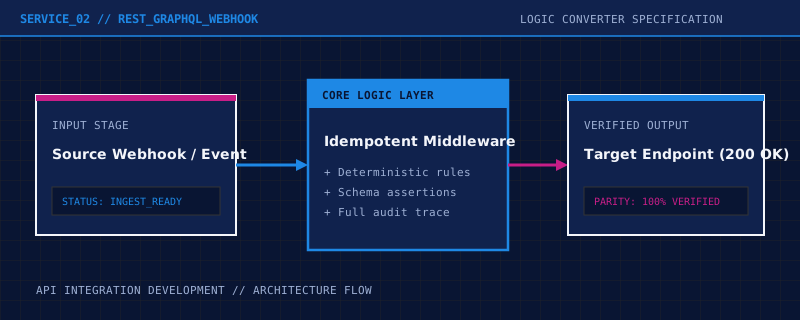
Production-grade REST, GraphQL, webhook, and file-based integrations engineered with idempotency, retries, and clear logging.
01 · Problem & Audience
Off-the-shelf no-code connectors often break when an API rate-limits requests, returns partial payloads, or requires multi-step conditional logic. Businesses need integrations that handle network hiccups gracefully, validate payloads before writing, and alert operators when manual intervention is genuinely needed.
Designed For
02 · Scope & Process
Phase 01
We define exact request/response schemas, authentication flows (OAuth2, API keys, mTLS), and edge-case rules.
Phase 02
We build the integration service with rate-limit backoff, idempotent request keys, and dead-letter handling.
Phase 03
We test against sandbox environments and simulated failure states (timeouts, malformed payloads, duplicate webhooks).
Phase 04
We deploy the integration with structured logging and provide full documentation for your technical team.
03 · Practical Benefits
04 · Deliverables
05 · Boundaries & Dependencies
Transparent engineering constraints
06 · Service FAQs
We design integrations with queuing and exponential backoff so outbound updates wait safely until the target API recovers, rather than dropping records.
Secrets are never hardcoded. We configure environment-level secret stores or vault services in your hosting environment with least-privilege access.
Yes. We regularly bridge modern JSON/REST platforms with older SOAP/XML endpoints or SFTP file drops.
07 · Companion Capabilities
System Integration Consulting
Assess existing applications, data hand-offs and architectural requirements before writing integration code.
Workflow Orchestration
Coordinate multi-step scheduled tasks, dependencies and cross-system process state.
Integration Monitoring and Support
Structured logging, error handling, alerting and ongoing maintenance for production integrations.
08 · Technical Reading
Why Business Integrations Fail Without Clear Data Ownership
Most integration bugs are not caused by broken HTTP requests—they happen because two systems both believe they own the same customer, inventory, or invoice record.
API Architecture · 6 min readFive Checks Every API Integration Should Include
Getting an API request to return 200 OK on your development laptop is only 20% of the job. Here are the five engineering checks that keep production integrations running smoothly.
09 · Project Enquiry
Outline the applications, data formats, or rules involved. We will review your constraints and propose a structured path forward.