
What file formats can you convert?
We work with CSV, TSV, Excel (XLSX), JSON, XML, YAML, fixed-width text, EDI segments, and SQL database dumps.
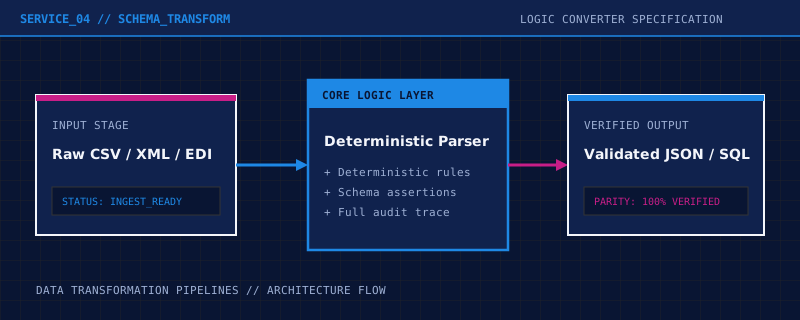
Convert spreadsheets, XML, EDI, JSON, and custom flat files into clean, schema-validated records with every rule explicitly tested.
01 · Problem & Audience
Suppliers, clients, and internal departments often exchange data in incompatible shapes—nested XML, multi-tab spreadsheets, legacy fixed-width files, or inconsistent CSVs. Manually reformatting these files in Excel introduces human error and consumes hours of skilled staff time every week.
Designed For
02 · Scope & Process
Phase 01
We specify strict parser rules for the source format and target schema definitions.
Phase 02
We write deterministic conversion functions covering character encodings, unit conversions, date normalisation, and lookup enrichment.
Phase 03
We build clear rejection reports that pinpoint exact row and column failures without halting valid records (or fail-atomic when required).
Phase 04
We verify the pipeline against real-world sample files and edge-case test fixtures.
03 · Practical Benefits
04 · Deliverables
05 · Boundaries & Dependencies
Transparent engineering constraints
06 · Service FAQs
We work with CSV, TSV, Excel (XLSX), JSON, XML, YAML, fixed-width text, EDI segments, and SQL database dumps.
Depending on your business rule, the pipeline can either reject the entire batch atomically or process valid rows while outputting a structured exception report for the rejected rows.
Yes. We can wrap the transformation pipeline in a simple internal web upload tool, watched folder, or automated email/SFTP listener.
07 · Companion Capabilities
ETL and ELT Pipeline Development
Structured extraction, loading and transformation pipelines for reporting and operational data warehouses.
Data Quality and Validation
Automated checks for completeness, schema compliance, duplication and cross-system consistency.
Data Migration Planning
Map source-to-target fields, clean historical records and validate migration readiness before cutover.
08 · Technical Reading
ETL vs ELT: Choosing the Right Data Pipeline Approach
Should you clean and reshape data before it reaches your target database, or load raw records first and transform them in place? Here is how to choose based on governance, volume, and maintainability.
Migration · 8 min readHow to Plan a Low-Risk Data Migration
Data migrations fail when treated as a last-minute CSV import before launch. A structured plan with automated reconciliation turns cutover weekend into a predictable checklist.
Automation · 5 min readHow Workflow Automation Can Reduce Manual Data Entry
Manual copy-pasting between emails, spreadsheets, and business software slows down operations. Learn how to identify high-value candidates for deterministic automation.
09 · Project Enquiry
Outline the applications, data formats, or rules involved. We will review your constraints and propose a structured path forward.