
Skip to content
Service 03Data & Pipelines

Data Migration Planning

Structured planning, schema mapping, and dry-run verification to move business data between platforms without losing history or integrity.

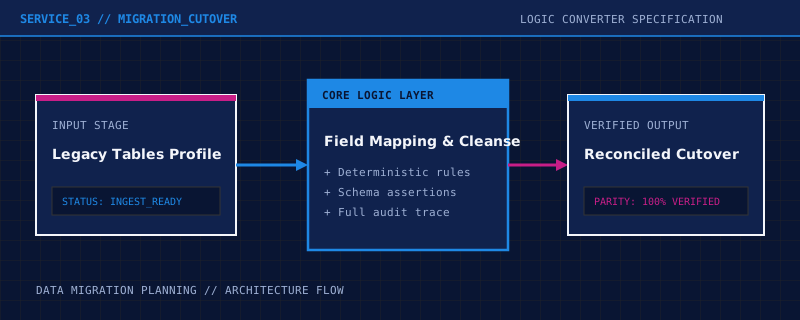
Data Migration Planning architecture flow diagram showing input stage, core logic layer, and verified output

01 · Problem & Audience

Why organisations need this

Moving to a new ERP, CRM, or industry platform often stalls because legacy data is messy: inconsistent date formats, orphaned records, duplicate contacts, and custom fields that have no direct equivalent in the new system. Rushing a migration without a formal plan leads to broken reports and operational disruption on day one.

Designed For

  • Organisations transitioning from legacy software to a new core platform.
  • Teams consolidating data from multiple databases after a restructure or system upgrade.
  • Project managers seeking an independent technical plan for data extraction, cleansing, and cutover.

02 · Scope & Process

How we execute Data Migration Planning

Phase 01

Source Data Profiling

We inspect legacy tables and exports to measure completeness, detect duplicates, and flag encoding or formatting anomalies.

Phase 02

Field-by-Field Mapping Specification

We map every source column to its target destination, documenting lookup tables, default values, and transformation rules.

Phase 03

Cleansing & Reconciliation Rules

We define automated validation rules and reconciliation totals (row counts, financial sums, relational integrity checks).

Phase 04

Cutover Runbook & Rollback Plan

We sequence the trial migrations, freeze windows, verification sign-offs, and fallback procedures.

03 · Practical Benefits

Operational Outcomes

  • +Early detection of schema mismatches and corrupt historical records before launch deadlines.
  • +Auditable reconciliation checks that prove every expected record arrived intact.
  • +Clear separation between historical archive data and active operational records.
  • +Reduced downtime during the final cutover window.

04 · Deliverables

What You Receive

  • →Data quality profiling report highlighting anomalies in source systems.
  • →Source-to-target field mapping workbook and transformation logic rules.
  • →Reconciliation test plan and acceptance criteria.
  • →Step-by-step cutover schedule and rollback protocol.

05 · Boundaries & Dependencies

Scope Limitations

Transparent engineering constraints

  • Business stakeholders must sign off on domain decisions (e.g., which duplicate customer record is authoritative when both are active).
  • Target system import speeds and API batch limits dictate the minimum cutover window duration.

06 · Service FAQs

Common questions about Data Migration Planning

Should we migrate all historical data or only active records?

We help you evaluate both options. Often, migrating active records plus summary balances into the live system while keeping raw historical logs in a searchable archive reduces complexity and cost.

How do you verify nothing was lost during migration?

We build automated reconciliation scripts that compare record counts, hash checksums, and key financial or inventory totals between source and target.

Can you also execute the migration scripts after planning?

Yes. Once the mapping and validation plan is approved, we can build and run the transformation pipelines for trial and final cutovers.

09 · Project Enquiry

Scope your data migration planning project.

Outline the applications, data formats, or rules involved. We will review your constraints and propose a structured path forward.