
How Workflow Automation Can Reduce Manual Data Entry
Manual copy-pasting between emails, spreadsheets, and business software slows down operations. Learn how to identify high-value candidates for deterministic automation.
Section 01
Spotting the Hidden Cost of "Swivel-Chair" Integration
In many growing businesses, the integration layer is a person sitting between two browser tabs—downloading a CSV from an e-commerce portal or customer form, adjusting columns in Excel, checking a pricing table, and typing the result into an accounting or dispatch system.
Beyond the direct hours spent, manual re-keying introduces transcription errors (transposed digits, wrong unit measures, or missed notes) that take ten times longer to unwind once an order or invoice has been issued.
Section 02
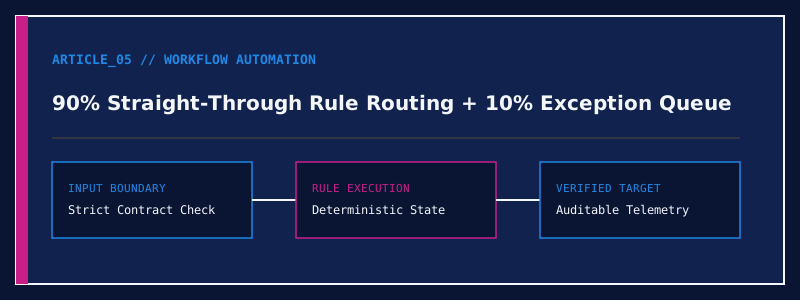
Automating the 90% While Routing the 10% Exceptions
A common misconception is that a process cannot be automated because "some orders have special requirements." Good workflow engineering does not try to force ambiguous edge cases through rigid rules.
Instead, deterministic automation handles the 85–95% of transactions that pass all standard validation gates immediately, while flagging the remaining exceptions with a clear reason code so staff only spend time on cases that genuinely need human judgment.
Implementation Checklist
- [✓]Audit weekly tasks where staff copy data between spreadsheets and software.
- [✓]Document the exact validation rules and lookup tables staff apply mentally.
- [✓]Build automated intake and transformation for standard records.
- [✓]Create a clean exception queue for records that fall outside standard thresholds.
Section 03
Keeping Business Rules Readable and Maintainable
When automating approvals, routing, or calculations, avoid burying thresholds deep inside spaghetti code. Structuring business rules as explicit, testable decision tables means your team can review and update policies transparently as the business evolves.