
Is this AI or deterministic rule automation?
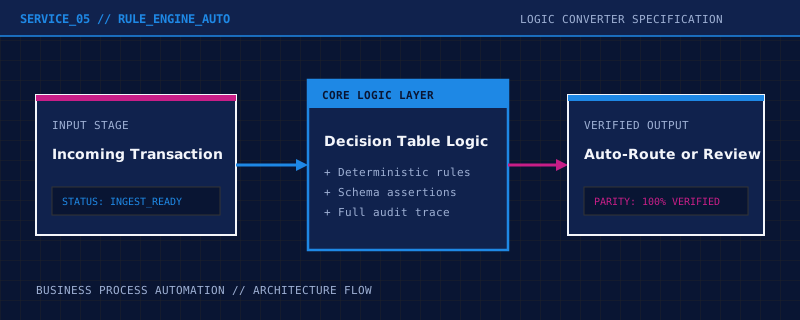
Our focus is deterministic, rule-based automation where identical inputs always produce the exact same verifiable output—essential for financial, inventory, and compliance workflows.
Replace repetitive manual checks, calculations, and cross-system copy-pasting with auditable, rule-driven software workflows.
01 · Problem & Audience
Skilled staff often spend hours each week performing deterministic checks—verifying order eligibility, calculating tiered pricing, cross-checking compliance fields, or copying approved records from one system to another. When rules live only in spreadsheets or staff memory, decisions become inconsistent and bottlenecks form.
Designed For
02 · Scope & Process
Phase 01
We shadow the current manual workflow, documenting every trigger, condition, calculation, and exception path.
Phase 02
We translate tribal knowledge into explicit decision tables and boolean rules that business owners can read and verify.
Phase 03
We implement the automated workflow, routing standard cases straight through and flagging ambiguous cases for human review.
Phase 04
We run the automation alongside manual processing to verify 100% rule accuracy before switching to live execution.
03 · Practical Benefits
04 · Deliverables
05 · Boundaries & Dependencies
Transparent engineering constraints
06 · Service FAQs
Our focus is deterministic, rule-based automation where identical inputs always produce the exact same verifiable output—essential for financial, inventory, and compliance workflows.
We build explicit exception handling. Any record that falls outside defined thresholds is paused and routed to a staff member with context on which rule flagged it.
Yes. We structure rules in readable configuration or decision tables so authorised staff or developers can adjust parameters safely.
07 · Companion Capabilities
Workflow Orchestration
Coordinate multi-step scheduled tasks, dependencies and cross-system process state.
Data Transformation Pipelines
Deterministic validation, mapping and controlled transformation workflows for complex formats.
API Integration Development
Build, test and document reliable connections between approved cloud and on-premise platforms.
09 · Project Enquiry
Outline the applications, data formats, or rules involved. We will review your constraints and propose a structured path forward.