
Can you monitor integrations that your team did not originally build?
Yes, provided we have access to the source code and hosting environment. We start with an observability audit to add structured logging and error handling where needed.
Keep critical data pipelines and API connections healthy as third-party schemas, certificates, and business volumes change.
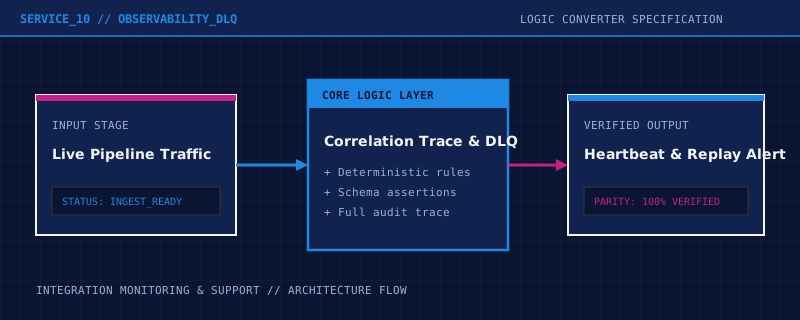
01 · Problem & Audience
Integrations are not "set and forget." External SaaS vendors deprecate API versions, rotate SSL certificates, tighten rate limits, or add new mandatory fields. Without proactive monitoring, a silent integration failure is often only discovered weeks later when a customer complains or financial totals do not balance.
Designed For
02 · Scope & Process
Phase 01
We review existing integration code, adding correlation IDs, structured logs, and payload metadata tracking.
Phase 02
We configure actionable alerts (separating transient retries from genuine failures) and safe dead-letter queues for failed payloads.
Phase 03
We set up heartbeat monitors, token-expiry warnings, and periodic row-count sanity checks.
Phase 04
We handle vendor API version upgrades, dependency patches, and minor rule adjustments under an agreed support structure.
03 · Practical Benefits
04 · Deliverables
05 · Boundaries & Dependencies
Transparent engineering constraints
06 · Service FAQs
Yes, provided we have access to the source code and hosting environment. We start with an observability audit to add structured logging and error handling where needed.
Transient network blips are handled silently by automated retries with backoff. Alerts only fire when retries are exhausted, error rates cross a threshold, or a heartbeat check fails.
No. We configure log redaction so correlation IDs, record IDs, and status codes are logged clearly while sensitive personal or payment fields are masked.
07 · Companion Capabilities
API Integration Development
Build, test and document reliable connections between approved cloud and on-premise platforms.
Workflow Orchestration
Coordinate multi-step scheduled tasks, dependencies and cross-system process state.
System Integration Consulting
Assess existing applications, data hand-offs and architectural requirements before writing integration code.
08 · Technical Reading
09 · Project Enquiry
Outline the applications, data formats, or rules involved. We will review your constraints and propose a structured path forward.